

Recent post
Showing posts with label SNES. Show all posts

Chrono Trigger writer Masato Kato both directed and wrote the main scenario. Due to his attitude at the time, the plot and tone were considerably darker than Chrono Trigger, though the additional scenarists wrote alternate scenarios with comedic tones. The music was scored by Yasunori Mitsuda, who had worked on Chrono Trigger. Production was completed in three months, and Kato was left unsatisfied with its quality.
As with most Satellaview titles, Radical Dreamers did not receive a lasting commercial release, and was exclusive to Japan. Attempts to bundle the game with the PlayStation port of Chrono Trigger were stopped by Kato due to quality concerns. The ROM for the game was released onto the web, allowing for the production of an English fan translation. While limited, its coverage in news and fan sites have praised its narrative and tone. Kato would later used plot elements from Radical Dreamers in his next game Chrono Cross.
DOWNLOAD: MEGA (2 MB)
 Shin Megami Tensei If...[a] is a Japanese role-playing video game developed and published by Atlus in 1994 for the Super Famicom. It is a spin-off from the Shin Megami Tensei series, itself part of the larger Megami Tensei franchise. Since release, it has been ported to mobile devices, the PlayStation and Microsoft Windows, and re-released digitally through Nintendo's Virtual Console service. The story follows a student of Karukozaka High School after their school is sucked into the realm of demons by a vengeful student's demon summoning spell going wrong.
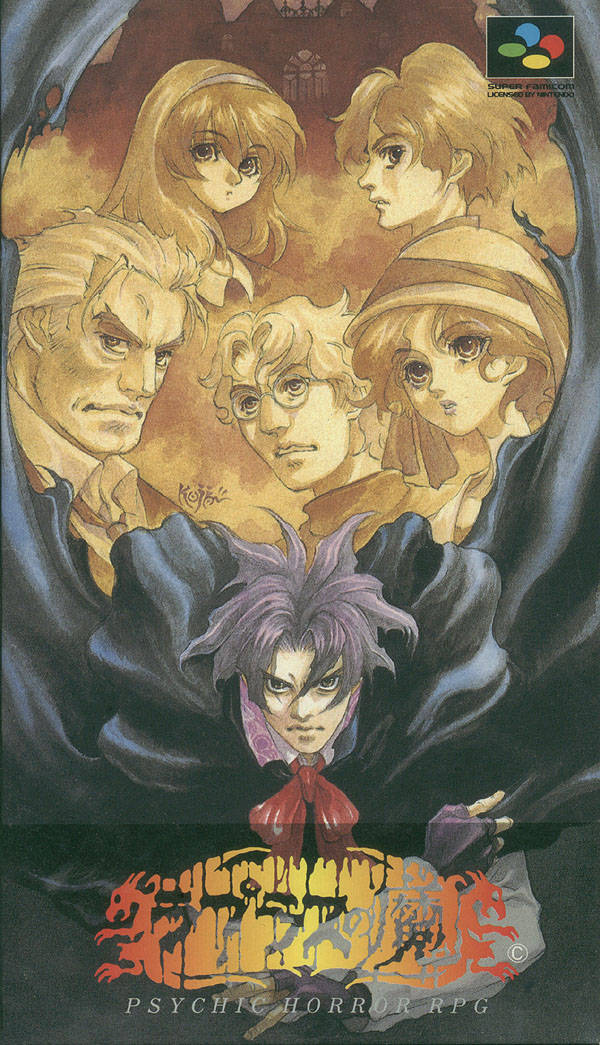 Laplace no Ma (ラプラスの魔, Rapurasu no Ma, literally "Laplace's Demon") is a Japanese video game released in 1987 for the NEC PC-8801 and NEC PC-9801.[1] The game was also ported to Sharp X68000, MSX, the SNES and TurboGrafx-CD.
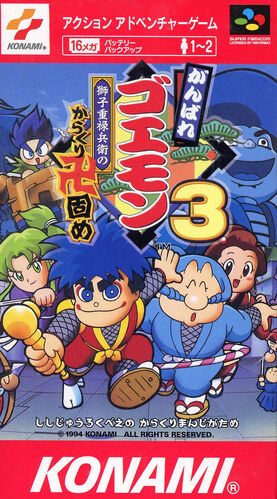 Ganbare Goemon 3: Shishijūrokubē no Karakuri Manji Gatame (がんばれゴエモン3~獅子重禄兵衛のからくり卍固め~?) is an action/adventure platformer video game developed and published by Konami, and originally released for the Super Famicom on December 16, 1994 in Japan. It is part of Konami's popular Ganbare Goemon series, and the third one of the franchise on that console.
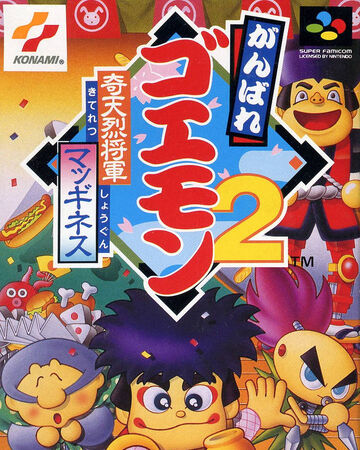 Ganbare Goemon 2: Kiteretsu Shōgun Magginesu (がんばれゴエモン2 奇天烈将軍マッギネス? lit. "Let's Go! Goemon 2: Very Strange General McGuiness") is a Super Famicom game by Konami released only in Japan, and the second of the SNES Ganbare Goemon games. This game was re-released along the first SNES Ganbare Goemon: Yuki-Hime Kyūshutsu Emaki (which was released outside Japan as The Legend of the Mystical Ninja) in a Game Boy Advance compilation, which also remained in Japan. This game marks the debut of Goemon's giant robot Impact and of the clockwork ninja Sasuke as a playable character (he previously debuted in Legend of the Mystical Ninja as a boss). The game has similarities to Super Mario World but it is shorter and arguably much more difficult.
![Torneko no Daibouken : Fushigi no Dungeon [Japan] - Super Nintendo ...](https://photos.wowroms.com/emulators-roms-logo/48/29942/420-420/Torneko+no+Daibouken+-+Fushigi+no+Dungeon+(Japan)+(Rev+1)-image.jpg) Torneko no Daibōken: Fushigi no Dungeon[a] is the first game in the Mystery Dungeon series. It features Torneko (or Taloon, as he is known in North America), the merchant from Dragon Warrior IV, and his adventures around the Mystery Dungeon in search of items.
Torneko no Daibōken: Fushigi no Dungeon[a] is the first game in the Mystery Dungeon series. It features Torneko (or Taloon, as he is known in North America), the merchant from Dragon Warrior IV, and his adventures around the Mystery Dungeon in search of items. Dragon Quest III: The Seeds of Salvation,[a] titled Dragon Warrior III when initially localized to North America, is a role-playing video game developed by Chunsoft and published by Enix. It is the third installment in the Dragon Quest series and was first released for the Family Computer (Famicom) in Japan and later for the Nintendo Entertainment System (NES) in North America. The game saw an enhanced remake for the Super Famicom (the Japanese release of the Super NES) in 1996 and the Game Boy Color in 2001, and a port to mobile phones and the Wii in 2009 and 2011. A version of the game for Android and iOS was released in Japan on September 25, 2014,[1] and worldwide as Dragon Quest III: The Seeds of Salvation on December 4, 2014. It was the first time the game was given an official English subtitle.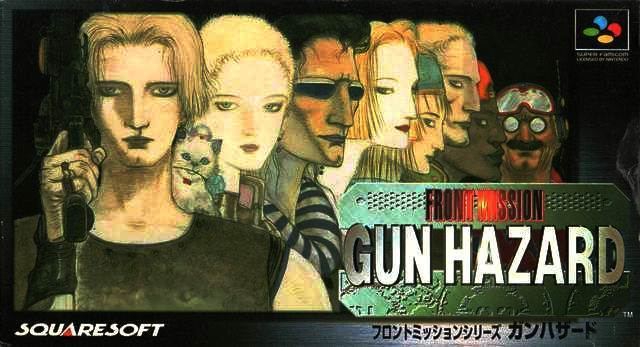
DOWNLOAD: MEGA
SIZE: 2MB
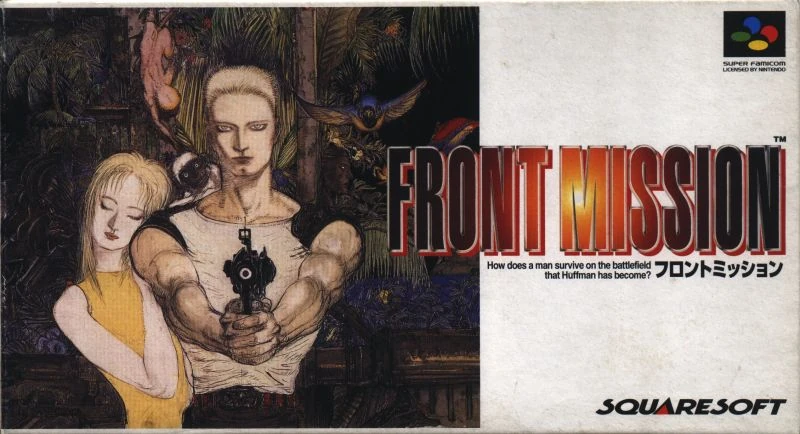
A port of the game developed by Square Enix Co., Ltd. was released for the PlayStation in Japan on October 23, 2003, titled Front Mission First (フロントミッション ザ・ファスト). It included new content and offered a new USN scenario to play through. The PlayStation version was then ported to the Nintendo DS with more additional content and was released in Japan on March 22, 2007. Only the Nintendo DS port, renamed as Front Mission, was released in North America on October 23, 2007. This release marked the third time that a Front Mission title was localized and published outside Japan. It was released as a PSOne Classic in Japan on November 11, 2008.
DOWNLOAD: MEGA
Size: 2MB
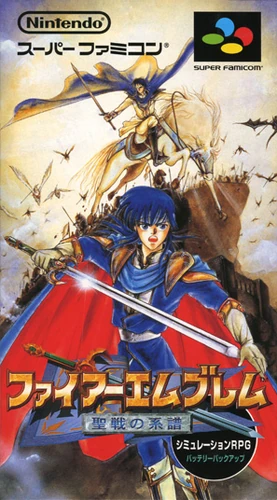 Fire Emblem: Genealogy of the Holy War (ファイアーエムブレム 聖戦の系譜 Faiā Emuburemu: Seisen no Keifu), is a Japanese Super Famicom tactical role-playing game developed by Intelligent Systems and published by Nintendo. It was released on May 14, 1996 in Japan. It is the fourth title in the Fire Emblem series, the second Fire Emblem title for the Super Famicom, and the last game produced by the late Gunpei Yokoi. It was released on the Japanese Virtual Console service on January 30, 2007. The game was originally to be titled as Fire Emblem: Light Inheritors.
*This is the Re-Translation project made by Project Naga! It's still on BETA, but it's better than the other one.*
Check it out this link for more info: ROMHacking
Download: MegaUp (3.18 MB)
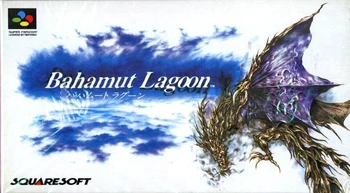
While the game has no relation to the Final Fantasy series, it incorporates several staples from the series, most prominently the use of summons. However, during development, the game was originally called Final Fantasy Tactics, a name used for a PlayStation game a year later. Bahamut Lagoon and Final Fantasy Tactics are both turn-based strategy RPGs, although they feature very different battle mechanics.
The game's development staff included many key members from the Final Fantasy series, including Final Fantasy creator Hironobu Sakaguchi, as a supervisor, Kazushige Nojima as director, and Motomu Toriyama as a story planner.
Download: MEGA (3.0 MB)
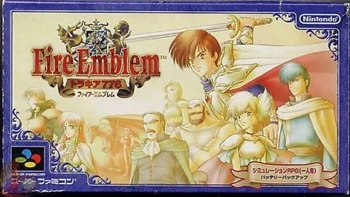
Fire Emblem: Thracia 776 is a midquel that takes place between Chapter 5 and Chapter 8 of the previous game, Genealogy of the Holy War, a year before Chapter 6 specifically. The setting and game events occur on the Thracian peninsula in southeastern Jugdral in Gran Calendar Year 776, hence the game's title. This game follows Leif as the main Protagonist. Characters include those from Genealogy of the Holy War, such as Finn, Diarmuid, and Nanna. Several other characters from Genealogy of the Holy War make cameos, such as Seliph (the main protagonist in part 2 in Genealogy of the Holy War), Julius, Julia, Altena, Coirpre, and Hannibal. There are also original characters, such as Halvan, Orsin, Lifis, Shiva, Dagdar, Machyua, and Mareeta.
Download: MegaUp (6 MB)
Download: MegaUp (4 MB)
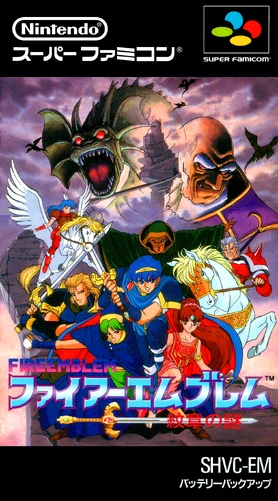
Book 1 of the game heavily influenced the soundtrack, graphics, mechanics, gameplay, and art style of Shadow Dragon, despite that game being touted as a remake of the first game and including the removed chapters and characters. Book 2 received an extensive remake in the form of Fire Emblem: New Mystery of the Emblem.
Download: MegaUp (4 MB)